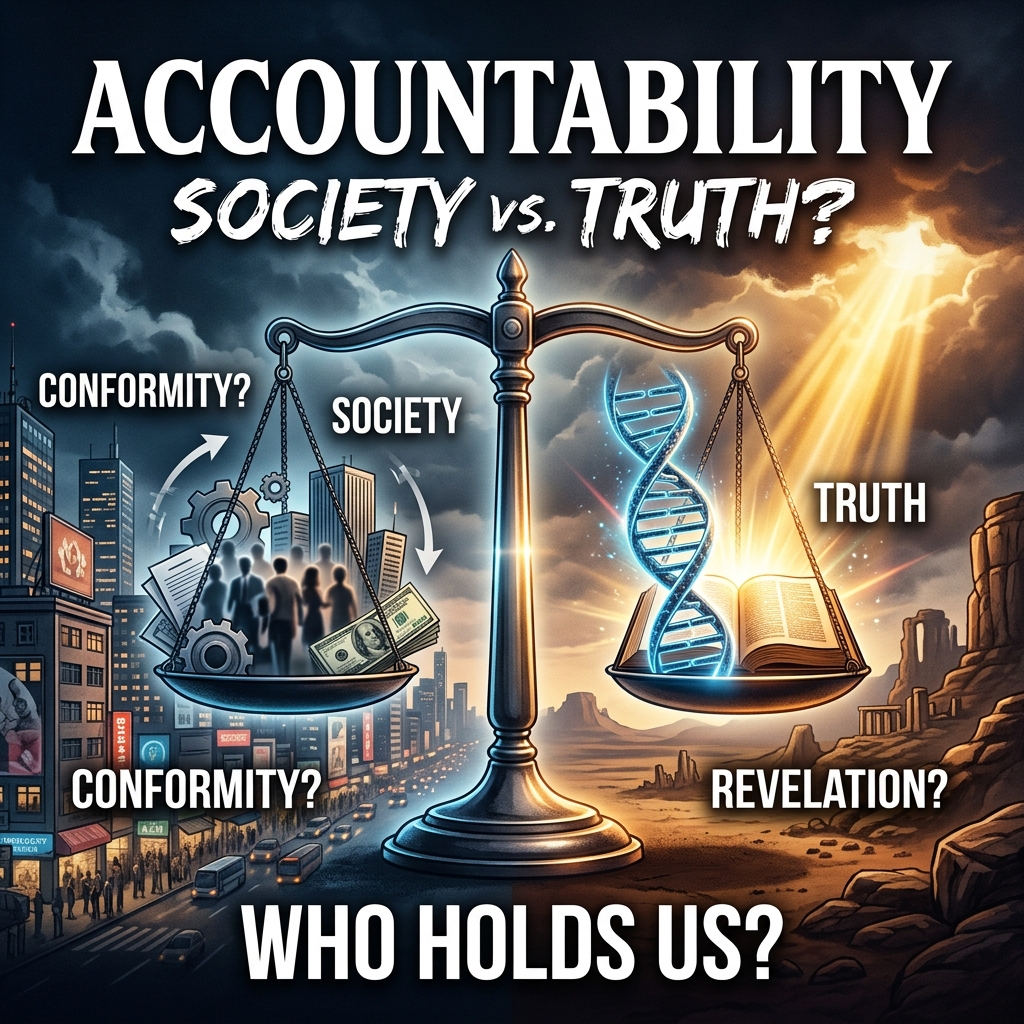
"Just be happy!" That's what society says. Don't feel guilty. Don't look back. Redefine the rules until the rules no longer apply to you. From law reforms to social media echo chambers, from classrooms that let students retake quizzes endlessly to workplaces drowning in corporate doublespeak, the cultural drift away from accountability is real, measurable, and dangerous.
But here's what no motivational reel or trending hashtag will tell you: removing accountability doesn't free people. It traps them. It stifles growth, corrodes relationships, and, according to both the Bible and neuroscience, works directly against how human beings are designed to function.
This post breaks down exactly why the accountability crisis exists, what God's Word has said about it since the beginning of time, and what science confirms about the human brain's need for ownership. More importantly, it shows you what you can do about it, starting today.
Why Is Society Abandoning Accountability?
The shift didn't happen overnight. Several cultural and structural forces have quietly chipped away at the foundation of personal responsibility.
The "System" as a Shield
Complex, multi-layered bureaucracies - in government, in corporations, in schools - make it easier than ever to hide behind rules and procedures rather than make a personal decision. When blame can be distributed across a system, no one person ever truly owns the outcome.
The Fear of Saying Hard Truths
Let's be honest: the truth hurts. Leaders across industries are increasingly reluctant to hold people accountable for fear of being labeled harsh, creating conflict, or losing talent. The result? Mediocrity dressed up as compassion.
Poor Modeling at the Top
When accountability isn't practiced by senior leadership, it never filters down. Frontline employees can't be expected to own their mistakes when executives are publicly deflecting theirs.
The symptoms are easy to spot. Vague expectations. Constant blame-shifting. Safe, uninspired decisions. A growing gap between the people who set standards and those who are supposed to enforce them. This isn't just a corporate problem; it's a societal one.
What Does the Bible Say About Accountability and Consequences?
Long before psychology coined terms like "behavioral outcomes" or "neurological error signals," the Bible was clear: actions have consequences. Every. Single. Time.
Adam and Eve: The First Accountability Lesson (Genesis 3:23-24)
When Adam and Eve ate the forbidden fruit, God did not ignore the transgression. He banished them from the Garden of Eden, stationing cherubim and a flaming sword to guard the tree of life. The consequence was immediate, real, and permanent. This wasn't cruelty; it was clarity. Sin has a cost.
Cain's Curse: Running From Responsibility Doesn't Work (Genesis 4:11-16)
After Cain murdered his brother Abel, God did not look the other way. Cain was cursed so that the ground would no longer yield crops for him, and he was sentenced to be a restless wanderer. God even placed a mark on Cain, not to shame him publicly, but to protect him from retaliation. Even in consequence, God's justice carried mercy. But make no mistake: the accountability was non-negotiable.
Jonah and the Whale: You Can Run, But You Cannot Hide (Jonah 2:4)
Jonah fled from his God-given mission to preach to Nineveh. A violent storm followed. Sailors threw him overboard. Inside the belly of a great fish, Jonah finally acknowledged his distance from God (Jonah 2:4, NIV). His prayer from the depths was one of the most powerful acts of accountability in all of Scripture, and it preceded his restoration.
The pattern is unmistakable. Throughout the Bible, avoidance leads to suffering. Ownership leads to redemption. This is not a coincidence. This is design.
What Does Science Say About Accountability?
The Bible isn't alone in making the case. Modern science, from physics to neurology, confirms that accountability is hardwired into the fabric of reality.
Newton's Third Law: For Every Action, an Equal and Opposite Reaction
Sir Isaac Newton's Third Law states that for every action in nature, there is an equal and opposite reaction. This isn't just a physics principle; it's a universal truth. Every decision you make sets something in motion. Pretending otherwise doesn't change the physics. It just means you're unprepared for the reaction when it arrives.
Brain Science: Ownership Activates Your Best Thinking
Neurological research reveals that taking personal ownership engages two critical brain regions: the prefrontal cortex (responsible for decision-making) and the anterior cingulate cortex (responsible for conflict resolution). When expectations are clear and accountability is present, the brain functions more cohesively. When expectations go unmet without consequence, the brain triggers neurological "error signals", a built-in alarm system designed to prompt correction.
In short, your brain needs accountability to self-correct and grow.
The Yin and Yang of High Performance
Eastern philosophy's concept of Yin and Yang offers another lens: opposing but complementary forces working in balance. Applied to accountability, this means balancing firmness - holding people to high standards and clear metrics - with empathy, nurturing growth, psychological safety, and grace. Neither alone is sufficient. Together, they create cultures where accountability becomes a strength, not a threat.
History's Warning: What Happens When Accountability Disappears
If Scripture and science aren't enough, history makes the stakes impossible to ignore.
- The Fall of Unchecked Regimes: Totalitarian governments throughout the 20th century, shielded from internal opposition and accountability, dragged entire nations into devastating wars and atrocities.
- The 2008 Financial Crisis: A catastrophic lack of accountability among major financial institutions, driven by risky lending and inadequate regulatory oversight, wiped out trillions in global wealth and triggered a worldwide recession.
- The Enron Scandal (2001): Corporate executives at Enron fraudulently hid debt and inflated profits. The result? The company collapsed, thousands of jobs were lost, and billions in investor wealth evaporated.
Each of these disasters shares a common root: people in positions of power who decided the rules didn't apply to them. They were wrong. The consequences were catastrophic.
Who Is Behind the Accountability Lie, and Why It Matters
This is where faith and reality intersect most sharply. The Bible is clear: Satan's singular goal is to lie, kill, and destroy (John 10:10). He is the complete opposite of God the Father, the author of truth, life, and restoration. When society feeds a narrative that erases consequences, dismisses moral responsibility, and reframes sin as self-expression, it is not a neutral cultural shift. It is a spiritual strategy designed to unravel the very principles that keep individuals, families, and nations intact.
Do not be deceived. The "feel-good, all is good" message isn't liberation. It's a lie dressed up as freedom.
Why Accountability Is Actually Good News
Here's the turn: accountability is not punishment. It is power.
In life, accountability:
- Accelerates goal achievement, committing to a goal and having a system of accountability dramatically increases your chances of success
- Builds autonomy, taking ownership of your actions gives you greater control over your future
- Strengthens relationships, owning how your words and actions affect others reduces conflict and deepens trust
In business, accountability:
- Increases trust and reputation, clients and consumers build loyalty around leaders who own their mistakes
- Boosts productivity and morale, clear expectations eliminate confusion and help teams feel genuinely valued
- Drives continuous improvement, when leaders model accountability, their teams analyze performance rather than deflect blame
Accountability is the bridge between intention and achievement. And it is the foundation upon which God calls His people to build their lives.
How to Cultivate Accountability - Starting Now
Real accountability isn't built through punishment. It's built through structure, safety, and spiritual preparation.
Put On the Whole Armor of God (Ephesians 6:10 - 18)
The Apostle Paul doesn't call believers to white-knuckle their way through temptation. He calls them to equip themselves with truth, righteousness, peace, faith, salvation, and the Word of God. This is daily, intentional, active preparation for the battles that a world without accountability will inevitably bring.
Build Accountability Into Your Environment
Whether at home, at work, or in your community:
- Define clear roles: Everyone must know who owns what before a project, relationship, or plan begins.
- Shift to continuous feedback: Replace annual performance reviews or infrequent check-ins with regular, real-time coaching conversations.
- Create psychological safety: People take ownership of their mistakes in environments where they trust they will be supported through growth, not shamed into silence.
Accountability Is Not the Enemy. Avoidance Is
The cultural drift away from accountability is real. But it is not inevitable, and it is not winning where it matters most. God's Word has been consistent since Genesis. Newton's laws have never bent. Neuroscience keeps confirming what Scripture always knew: human beings are built for ownership.
The question is not whether accountability works. The evidence, biblical, scientific, and historical, is overwhelming. The question is whether you are willing to embrace it, even when culture tells you not to.
Take ownership. Pursue truth. Walk in the freedom that only responsibility can bring.
Frequently Asked Questions About Accountability
What does the Bible say about personal accountability?
The Bible consistently teaches that actions have consequences and that individuals are responsible before God for their choices. Key examples include Adam and Eve's banishment from Eden (Genesis 3:23–24), Cain's curse after murdering Abel (Genesis 4:11–16), and Jonah's acknowledgment of his disobedience from inside the great fish (Jonah 2:4). Scripture frames accountability not as punishment, but as a pathway to restoration.
What does science say about the importance of accountability?
Neuroscience shows that taking personal ownership activates the prefrontal cortex (decision-making) and the anterior cingulate cortex (conflict resolution), helping the brain self-correct and function more effectively. Newton's Third Law further confirms that every action produces a reaction; there are no consequence-free choices in the physical world.
Why is accountability declining in modern society?
Key drivers include multi-layered bureaucracies that diffuse personal responsibility, a growing fear of conflict and confrontation among leaders, poor modeling of accountability by senior executives, and a broader cultural emphasis on feelings over facts and comfort over correction.
What are the real-world consequences of a lack of accountability?
History offers stark examples: the 2008 global financial crisis, the Enron collapse in 2001, and the rise and fall of totalitarian regimes throughout the 20th century all share a common cause: systems where individuals faced no meaningful consequences for harmful choices.
How can I become more personally accountable?
Start by defining clear expectations in every area of your life. Seek an accountability partner, someone who will speak truth to you. Build daily practices of self-reflection and, for those of faith, put on the full armor of God as outlined in Ephesians 6:10-18. Shift your mindset from protecting your reputation to protecting your integrity.