Business, Stronger Customer Relationships
Discover how Zoho tools and Epoch Tech Solutions, LLC help professionals collect, organize, automate, and use business data to improve efficiency and customer experiences.

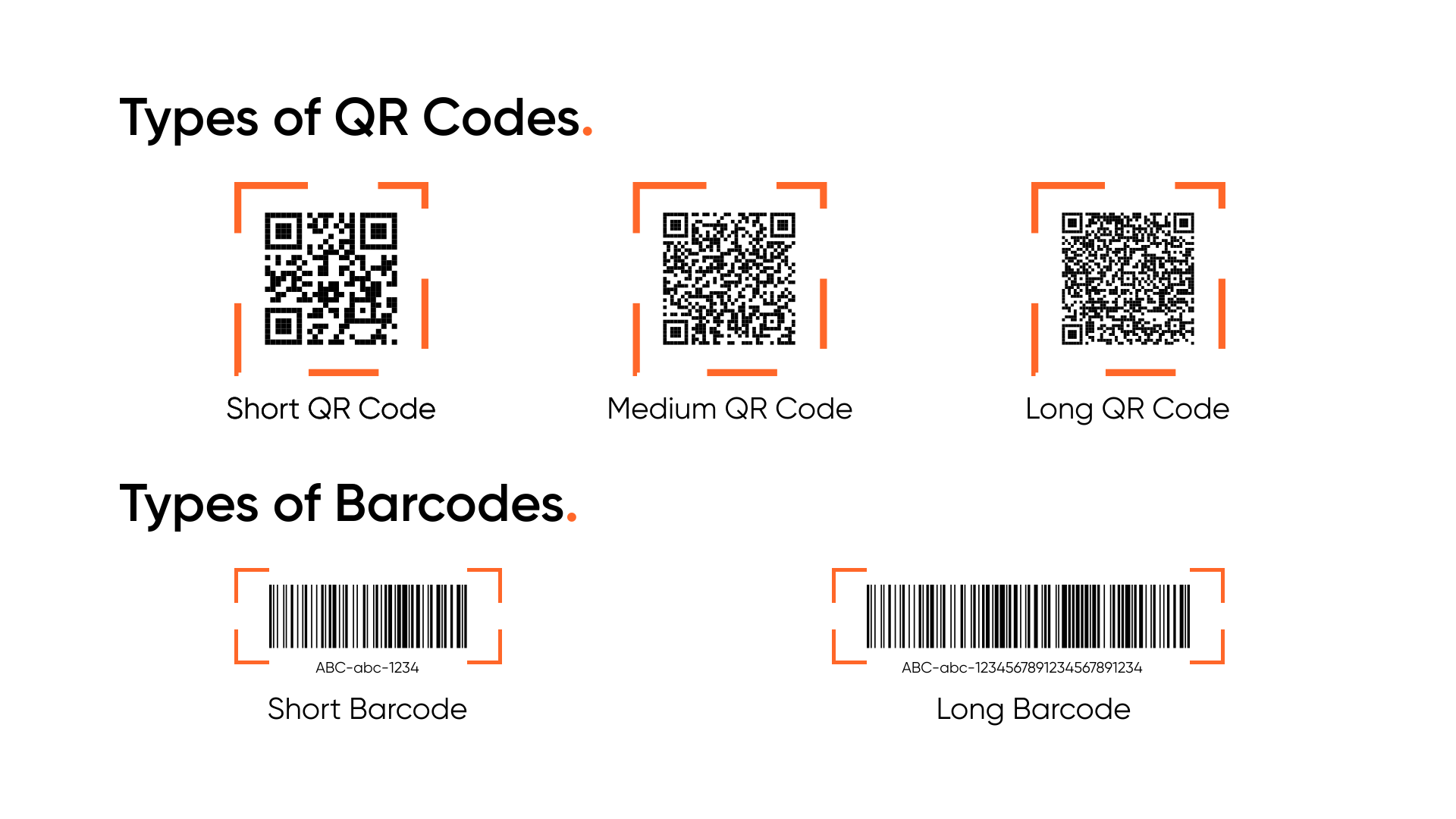
Are you struggling to manage inventory efficiently while keeping operational costs low? Do you want a business system that is better than your basic spreadsheet? For many small to medium-sized business owners, tracking products, engaging customers, and managing data can quickly become overwhelming. Choosing the right technology is the first critical step toward resolving these operational inefficiencies.
You need systems that are efficient, reliable, and proven. You also need technology that respects your budget, especially during the end of your fiscal year budgeting cycles. This is exactly where the debate between traditional barcodes and modern QR codes begins. Both serve as vital data collection tools, but they operate differently and offer unique benefits depending on your specific industry needs.
Understanding the technical distinctions and practical applications of these two systems will help you make an informed decision. By selecting the optimal data tracking method, you can increase sales, reduce your operational costs, and improve overall customer satisfaction. Let us explore the mechanics, benefits, and proven ROI of barcodes and QR codes, ensuring you implement the exact solution your business requires to thrive.
To make the best operational decision for your mid-level management team, you must first understand the fundamental differences between the technologies available to you. Both barcodes and QR codes are visual representations of data. However, the way they store and transmit that data is vastly different.
Barcodes are one-dimensional (1D), linear codes. They consist of a series of vertical black lines and white spaces of varying widths. You see them every day on grocery store items and retail packaging. Because they are 1D, they are read horizontally.
Traditional barcodes are relatively simple. They typically store between 8 and 20 characters of information. This limited capacity means they are strictly used for basic product identification. When a cashier scans a linear barcode, the scanner reads the numerical ID and queries your database to pull up the product name and price. They are highly effective for what they do, but their capabilities end at simple identification.
QR codes, or Quick Response codes, represent a massive leap forward in data collection and storage. These are two-dimensional (2D), square-based codes. Instead of simple lines, they use a grid of black and white squares.
Because they are 2D, QR codes are read both horizontally and vertically. This structural advantage allows them to hold up to 2,500 or more characters of information. With this massive data capacity, QR codes do not just store simple product IDs. They can house complex data, website links, digital menus, and entire contact cards. They empower your business to connect the physical world with your digital assets instantly.
Why should you choose one over the other? Are you looking for simple inventory control, or do you need a dynamic marketing tool to combat a quarterly sales slump? Let us look at the key differences between the two formats so you can align them with your core business objectives.
As mentioned, the data capacity difference is staggering. QR codes hold hundreds of times more data than 1D barcodes. A traditional barcode gives you a short string of numbers. A QR code gives you paragraphs of text, complex URLs, and interactive payment portals.
The structure dictates how this data is retrieved. Barcodes require a direct, horizontal line of sight to be read. QR codes can be scanned from almost any angle, making them incredibly flexible for consumer-facing applications.
Have you ever tried to scan a scratched barcode at a checkout register, only to have the system fail repeatedly? Barcodes are easily ruined by scratches, dirt, or slight tears. If the horizontal line is broken, the entire code becomes unreadable. This can slow down project turnarounds and frustrate both your staff and your customers.
QR codes are built with robust error correction technology. Even if a QR code is partially damaged, smudged, or covered, it often remains entirely scannable. This built-in reliability ensures seamless operations without frustrating downtime, securing your data collection processes in harsh warehouse environments or outdoor marketing campaigns.
Hardware costs are a primary concern for any budget-conscious manager. Traditional, thin barcodes frequently require specialized laser scanners. While these scanners are highly efficient for high-volume retail, they represent an additional capital investment.
Conversely, QR codes are specifically designed for smartphone cameras. Any modern smartphone can instantly recognize and scan a QR code without a specialized application. This opens up entirely new avenues for customer engagement, as your target audience already carries the necessary hardware in their pockets.
Despite the advanced capabilities of 2D codes, traditional 1D barcodes remain an incredibly powerful tool for specific operational workflows. When should you rely on linear barcodes?
If your primary concern is moving hundreds of items through a checkout lane quickly, barcodes are highly efficient. They are the global standard for retail point-of-sale systems. The scanning process is virtually instantaneous with dedicated hardware, making it the ultimate solution for rapid, repetitive transactions.
Do you need to track basic inventory movements across a small warehouse? Barcodes are exceptionally cost-effective for internal manufacturing tracking on small items. They require very little space to print and provide a reliable, proven method for updating inventory databases as products move from receiving to shipping.
If you want to push beyond basic inventory and actively engage your customers, QR codes are the definitive choice. They provide a consultative, interactive experience for your end-user.
Launch your new product with confidence using QR codes. You can place a QR code on your product packaging that directs customers to in-depth demo videos, warranty registration forms, or exclusive membership sign-ups. This direct line to your customer improves customer satisfaction and significantly enhances your brand reputation.
Small business owners must adapt to shifting industry trends. Consumers now expect fast, contactless payment options. QR codes facilitate secure digital payments, including UPI transactions, straight from a user's mobile device. Furthermore, URL redirection allows you to route customers to promotional landing pages, capturing their interest exactly when their buying intent is highest.
Customers demand transparency. A QR code on a product tag can link to detailed product information, sourcing materials, and nutritional facts. This detailed product insight builds trust and accelerates the buying timeline.
Implementing the right data tracking system directly impacts your financial bottom line. We understand that mid-level managers face pressure to justify every expense.
By implementing the correct code system, you eliminate manual data entry. You stop paying employees to manually count stock or type in lengthy serial numbers. This reduction in manual labor drastically reduces your operational costs. Many of our clients see their cost savings cover the price of implementation within the first three months.
When you use QR codes to connect your marketing through multiple routes, such as web pages, digital menus, and loyalty memberships, you create a frictionless buying experience. Case studies consistently show that businesses leveraging interactive QR codes for direct consumer engagement frequently experience an increased sales volume of 10% or higher.
To ensure you have total clarity before making a purchasing decision, here are answers to common questions regarding these systems.
No. Both QR codes and traditional barcodes are incredibly cost-effective to generate. The primary cost difference lies in the hardware you choose to deploy for scanning them internally, and the software used to manage the data they collect.
Absolutely. Many successful small to medium-sized businesses use traditional barcodes for internal warehouse inventory and QR codes on the exterior packaging for consumer marketing. This hybrid approach optimizes both internal processes and external engagement.
Data security is paramount. When you partner with a professional IT service provider, your dynamic QR codes are encrypted and routed through secure servers. This ensures your systems remain impenetrable fortresses, shielding your sensitive data and your customers' privacy.
You have the power to enhance efficiency, foster growth, and engage more customers today. Whether you need the rapid, high-volume scanning of a 1D barcode or the expansive, interactive capabilities of a 2D QR code, the right technology will revolutionize the way you run your business.
At Epoch Tech Solutions, we provide secure and cost-effective solutions tailored specifically to your industry. We have QR codes and barcodes designed perfectly for complex inventory management. We also have QR codes engineered to connect your marketing through multiple routes, empowering your B2C outreach.
We believe in a consultative approach. We offer flexible payment options that align with your budget cycles, ensuring no financial strain. With our 24/7 reliable support and in-depth product demonstrations, we guarantee your complete operational success.
Do not let outdated systems hold your business back. Contact Epoch Tech Solutions today for a detailed product demo and a personalized ROI calculation. Empower your growth and secure your competitive advantage now.